

I’ve spent a long time in the U.S. book industry. I’ve worked inside publishing houses large and small, reading hundreds of proposals, and guiding aspiring authors from dream to book contract.
In that time, you can bet I have seen a lot of authors who are doing it right, and I’ve also seen a lot of authors who are doing certain things deadass wrong.
I don’t want that to be you. So I’m outlining the top six new-author mistakes I see that are casting you in the wrong light with the agents and editors you want to impress.

Photo by Edemekong Andem on Unsplash
They’re the kind of things that look small if you’re outside the biz. But they’ll have an agent or editor clock you as a first-timer faster than you can say query letter.
The good news is that every single one of these mistakes is avoidable—and I’mma tell you how. So let’s get into it.
Author Mistake #1: Talking About Your Book in Pages
Inside the publishing industry, there is exactly one unit of measurement when it comes to discussing the length of your book. And crazy enough, it has nothing to do with pages.
I know, this one hurts. We are so proud of how many pages we have written! But stay with me.
Your “pages” and my “pages” are not the same. Font, spacing, margins…all of these subjective little choices will ultimately change your page count in a big way. So when you tell me your manuscript is 300 pages, I genuinely have no idea how long your book will be once it’s set into type.
What I need to know, instead, is your word count.
Think of it as the universal unit of measurement, used throughout the world. You know, like the metric system. *raises eyebrows at the U.S.*
So how many words should you aim for? It depends on the genre.
If you’re writing transformational nonfiction—self-help, personal growth, spirituality, how-to—aim for at least 55,000 words and no more than 75,000. (Insider trick: If you’re a first-time author, lean toward the low end. Short and sweet encourages new readers to take a chance on you.)
Fiction, especially genre fiction, can run longer: 75,000 to 100,000 words and often more. Whereas a children’s picture book needs to be teeny-weeny—we’re talking around 1,200 words.
So the amateur move is to come to me and tell me you’ve written a 15,000-word self-help manuscript.
Because, hard as you’ve worked on it, 15k words is not a book. It might be a really, really good read, but it’s a really good pamphlet.
To find your word count, go to the Tools dropdown in whichever word processing system you’re using. They’re all tracking your word count, and you should be, too.
Author Mistake #2: Submitting Like You Didn’t Read the Instructions
This one is about how you submit your manuscript or book proposal to an agent or publisher—and there is a lot that can go wrong here.
You will find all the information you need to know about the agent or publisher’s submission guidelines on their website. Usually it’s under a tab called, prepare yourself, “Submission Guidelines.”
First things first: Do not send your work to a publisher whose guidelines clearly state that they do not accept unsolicited submissions.
“Unsolicited” is the keyword that tells you the publisher requires an agent to submit, rather than an author.
Trust me, you will not be the exception here. If you send your work directly to a publisher who accepts only agented submissions, they’re not even going to read it.
Okay now that we’ve got that clear, the second thing you’re going to confirm is that the agent or publisher is actively looking for submissions in your genre. Meaning you are not going to send your romance novel to an agent who only represents business books. Capiche?
Next, and I don’t know how to say this any more clearly, you are going to follow their instructions to the letter. One hundred percent. Zero improvising.
Because agents and publishers are asking themselves not just “is the book a good bet?” but also, “is this author going to be easy to work with?” Meaning, are you organized? Can you follow instructions? Are you likely to hit your deadlines? Your submission gives a glimpse, before they’ve read a single word of your actual work.
Want to know one of the most common “deleted before it even gets read” level mistakes? Accidentally sending your query with the wrong editor’s or agent’s name on it. Rookie move, but one I’ve seen a million times. So proofread, proofread, proofread!
My top organizational recommendation: Create a simple spreadsheet—Google Sheets makes it easy—with columns for the agent’s name, agency URL, why you chose them, which of their titles you’ve read that are similar to your book, what materials they requested, when you sent it, and any other details you want to track.
And just a reminder that you’re very unlikely to hear back from every agent or publisher you submit to. That’s just how it works. So go forth, be professional, and don’t get discouraged. All it takes is one.
Author Mistake #3: The Generic Title
Almost every author I meet is sure they’ve got the perfect title. It fits their content perfectly! Their friends think it’s great!
So why, when they drop it in front of anyone in the book business, do they get a blank stare?
More often than not, it’s because the title they have chosen is vague, broad and overused. In a word: generic.
I’m talking about a title like Love Heals, which is the kind of title I see a lot of given that I operate in the space of self-help/spirituality.
Now, do I believe love heals? Yes, for real. But does this title tell your reader what your book is about? Which methodology you’re teaching? Anything at all about the story you’re telling? Nope, sure doesn’t.
Another example: Born for Love. (I’m using the word “love” twice in these examples because of how often I see it centered in titles in my space.)
I hear this title, and I ask myself:
Is this a memoir about a child who survived a terrible illness?
A guide to relationships?
A spiritual manifesto?
I have no idea—and if I don’t know, your reader definitely doesn’t know.
There’s really one purpose for your title if you are writing nonfiction: to tell the reader what to expect if they pick up the book.
They should read your title and have some idea of the genre, the benefits they’ll receive from reading it, or a sneak peek of your compelling and original story. Something that has them say, “Wow, this book is exactly what I’ve been looking for!” or “This is so intriguing—I need to find out more!”
One more thing about titles. Please, for the love of all that is holy, do not include puns in your title. I say this with genuine care: it’s not as cute as you think it is.
So how do you easily improve your title? Go look at the bookshelf you want your book to be sitting on. Study the titles that are working. See how the author has constructed the interplay between title and subtitle. Can you tell by reading the title roughly who the book is for? Do you have some clue what benefit you’ll get from reading it? Then model yours after those that are working. Your readers will thank you—and so will your book sales.
Author Mistake #4: Overhyping Your Book’s Potential
Once, when I was Associate Publisher at a spirituality press, I received a submission from a relatively unknown spiritual teacher. Intrigued by her work, we invited her to visit the office—where she sat across the desk from me and said with a straight face that her book was going to be bigger than the Bible.
I knew exactly what her manuscript was going to be as soon as she left…recycling.
Maybe you’re not quite that confident (delusional?). But you might still think it’s a good idea to hype your book in your proposal.
You know, insisting it’s going to be the next The Power of Now. Claiming with little back-up that it’s bound to sell as well as Mel Robbins. Insinuating that Sarah J. Maas should be shaking in her boots right about now.
Look, I understand the impulse—you love your book, and you want everyone to know it’s special.
But what the publisher knows, that you may not, is that the megabestsellers represent lightning striking a million times in the same spot.
Even if your book is objectively that good, agents and editors know there is truly no guarantee that your book is going to be a breakout.
We’ve had our hearts broken by too many amazing books that withered on the vine instead of knocking it out of the park. (Forgive the mixed metaphor.)
While yes, every agent and editor wants an outlier, we also know there’s no way to guarantee that outcome. What we want more than anything is a spidey sense that it’s going to be a solid seller for years to come.
So when you’re selecting competitive titles to include in your book proposal, don’t reach for the three biggest bestsellers of all time.
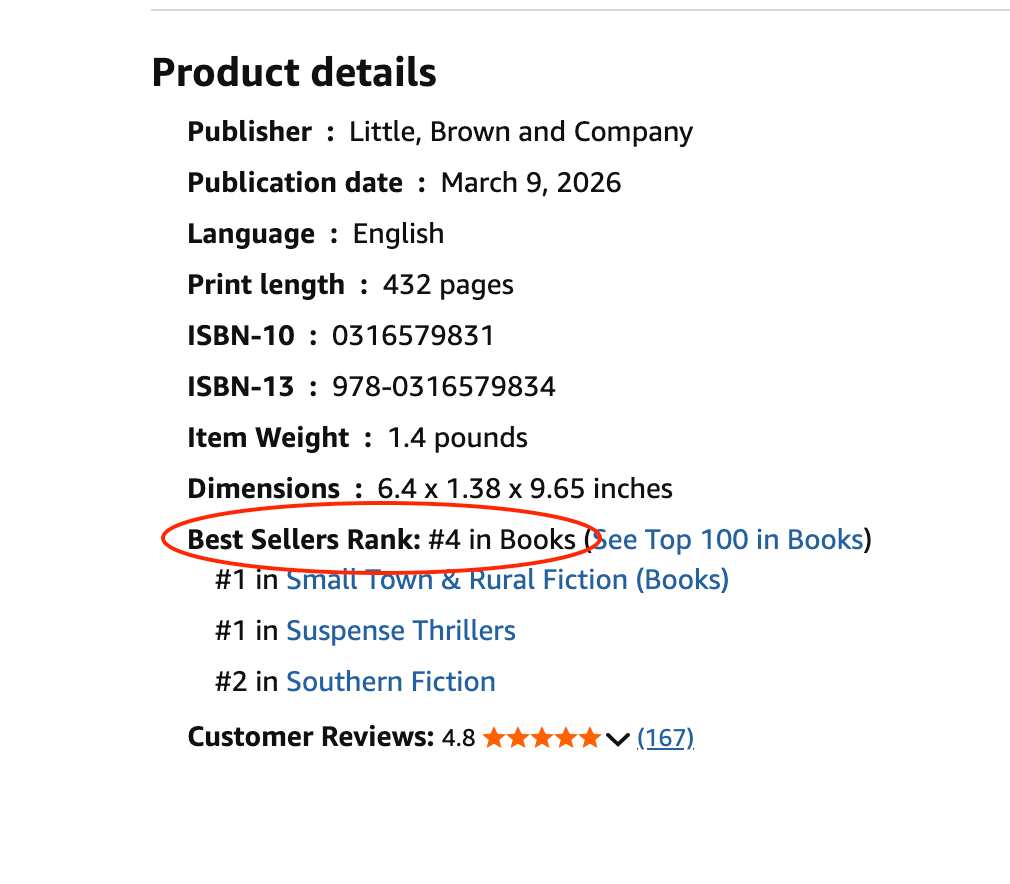
Instead, look for books that have been published recently—in the last year or two—that are doing well. How do you know if they’re doing well? Check their overall Amazon Best Sellers ranking. Any book that is consistently ranking between 0 and 20,000 is doing fairly well.
Note: You are looking for Amazon’s overall “Best Sellers Rank.” Not in a subcategory. Overall, meaning out of all the books that are selling right now in any category. That’s a critical distinction. Here’s where to look (and yes, I’m super proud of myself for figuring out how to circle it in red, TYVM):
Author Mistake #5: Editing Before You Have a First Draft
Okay, this one is a little different from the rest because it’s not technically a mistake that will make you look amateur in front of publishers.
It’s an amateur mistake that often means your book or proposal will never be seen by an agent or publisher.
Why? Because you’ll never actually finish it.
Editing your work before you have a complete first draft is one of the most effective ways I know to ensure your book never gets written.
When I say “a complete first draft,” I mean it. A full draft of your manuscript, your book proposal, your Substack article, etc. Whatever you’re working on, you’re going to draft the whole darn thing, start to finish, before you go back and touch a word of it.
“But you’re an editor!” you may be thinking. “How could you be anti-editing?”
I’m not anti-editing. I’m anti going-back-over-that-one-paragraph-a-million-times. I’m anti imagining-how-your-worst-enemy-will-feel-about-this-sentence-so-you-must-rewrite-it-again.
Because if this is how you’re spending your writing time, you’re in what I call a rabbit hole of doom.
This is the place where you’re circling the drain for hours, days, weeks—yes, even years. Where you never make any progress because you never feel like you got this one part just right.
What professional writers know is that first drafts aren’t supposed to be good.
They’re supposed to be a mess.
Because the first draft is just how you get something on the page that you can go back and work with. (Witness me here, editing every sentence in this extremely long post a day after I got the whole thing down on the page. True story.)
Once it’s on the page, you can actually see it. You can evaluate it as a whole. And you can edit it into something great.
But you cannot edit something that doesn’t exist yet.
So do yourself a favor and declare a full moratorium on editing until your first draft is done. You will thank yourself later.
Author Mistake #6: Not Reading in Your Genre
Every single time I hear this from an aspiring author, it crushes my little heart.
Me: Amazing that you’re writing a memoir! I love memoir. What’s the best memoir you’ve read recently?
You: [with a tiny amount of disdain] Oh, I don’t read memoir.
I’m serious. The number of times I’ve had this conversation with an author is too many to count. And the smug disdain is the most puzzling!
If you have not read deeply on the bookshelf where you want your book to sit, how are you going to know what the readers of your genre love reading? How will you know what’s working right now, so you can position your own book to reach that same market?
Some authors worry that if they read their competition they’ll accidentally plagiarize one of the books they’ve read. Others are afraid of getting discouraged, seeing that “someone else has already written my book.”
If plagiarism is your concern, the antidote is to read so deeply in your genre that you couldn’t possibly be influenced by just one book.
Now, if you’re worried someone else has already written your book—and I say this with love—that’s an inside job. It’s up to you to do the personal work to transmute your insecurities into enthusiasm.
Because serious, successful authors read their competition. Full stop.
They see their author colleagues not as rivals, but as friends on the shelf. The ones they want to be sitting next to in the cafeteria.
And practically speaking: if you’re writing a book proposal, you have to read your competition. Your proposal requires comp titles, so there’s really no getting around it.
So—have you fallen for any of these amateur pitfalls?


